With more than 100 staff around the world, CIVIC is powered by people who bring insight, creativity, and deep care to their work every day.
We’re proud to share short spotlights on colleagues from across the organization. These snapshots are a small way to recognize the talent, humor, and determination that drive our mission forward—and to offer a glimpse of the people shaping how we protect civilians in conflict.
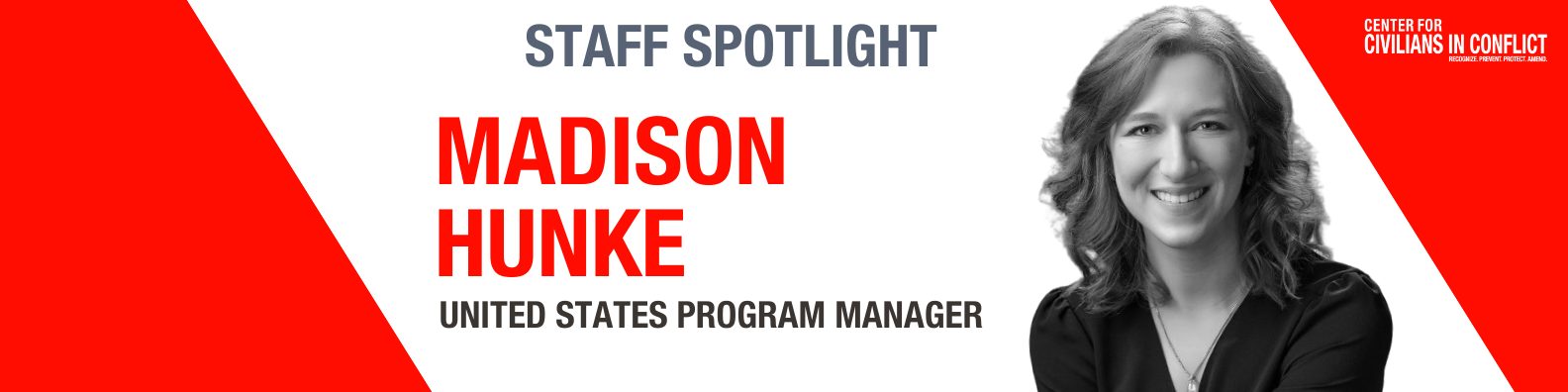
While studying Middle Eastern politics and human rights as a university student in the Midwest, the Syrian civil war and refugee crisis were unfolding across the globe. I began to understand the lasting impact of Washington’s policy decisions on the region and the disregard for civilian lives by global powers and non-state actors. I learned that civilians often pay the highest price in the chaos of war. Homes are destroyed, families torn apart, and communities left with irreparable loss.
During my graduate studies, I encountered Center for Civilians in Conflict (CIVIC), which envisions a world in which no civilian is harmed in conflict. CIVIC promotes evidence-based practices, greater accountability, and the inclusion of civilian voices in decision-making in supporting security forces to more effectively prevent and respond to civilian harm. Joining CIVIC as an intern for the U.S. Program gave me the opportunity to help promote a responsible and humane U.S. foreign policy, one that sees any loss of civilian life from its operations as a moral and strategic failure. Now, as CIVIC’s U.S. Program Manager, I advocate for policies and practices that prioritize the protection of civilians in U.S. military operations. CIVIC’s U.S. Program is policy-oriented and informs ongoing reforms of U.S. government policy.
Too often, the needs of civilians are overlooked in the decisions that most directly impact their lives. At CIVIC, we and our partners often serve as the only bridge between civilians and Washington policymakers, ensuring that the U.S. Government will not only hear those voices but act upon them.
We engage with the Department of Defense (DoD), Department of State, Congress, the White House, and various coalitions within the D.C. foreign policy space and work to ensure that the perspectives of those affected by conflict are included in the decision-making process.
One of our recent initiatives involves monitoring the DoD’s progress in implementing its Civilian Harm Mitigation and Response Action Plan (CHMR-AP), a major undertaking aimed at overhauling how the U.S. military prevents and responds to civilian harm caused by its operations. The plan spans four years and outlines more than a hundred concrete steps to prevent harm to civilians and respond more effectively when it does happen. Over the past year, my colleagues and I have taken on the challenging task of tracking the DoD’s progress on the Action Plan. We thoroughly examined hiring efforts, policy updates, and structural reforms, compiling a comprehensive report on the eleven thematic objectives and corresponding actions that must be underway by the end of fiscal year 2025. Reviewing its implementation has required a monumental amount of work—sifting through budget requests and policy updates, mapping the DoD’s massive bureaucracy, and engaging with personnel across the Department. Each piece of the plan, if implemented successfully, contributes toward making a tangible difference for civilians on the ground.
A significant achievement under this plan is the establishment of the Civilian Protection Center of Excellence (CP CoE). The Center serves as a hub for knowledge and analysis focused on mitigating civilian harm and has supported capacity building, doctrinal updates, and data management reform across the DoD. More than 160 personnel have been hired for roles specifically dedicated to preventing, assessing, and addressing civilian harm. For example, new civilian harm assessment teams have been introduced within combatant commands around the world, where no dedicated roles or desks for this work previously existed.
Despite these achievements, there is still a lot of work to be done. One area where we have seen slow progress is the DoD’s response to civilian harm. Only three ex gratia payments—condolence payments given to civilians harmed by military operations—have been made since Congress authorized $3 million annually for this purpose in 2020. There is also a need for greater consistency in how the U.S. addresses civilian harm across conflicts. One glaring example of this contradiction is the U.S. government’s policy commitments to prevent and mitigate civilian harm while simultaneously providing nearly unconditional support to the government of Israel in the face of catastrophic civilian harm using U.S. weapons in Gaza.
Civilian protection cannot be selective; it must be upheld as a non-negotiable standard.
As the CHMR-AP progresses toward its conclusion in 2025, our focus remains on ensuring that its commitments are fully and effectively implemented and a tangible impact can be seen by civilians on the ground. With the recent presidential transition and appointment of a new Secretary of Defense, CIVIC will work with Congress and the DoD to safeguard civilian protection policies and, after 2025 concludes, secure these reforms as permanent fixtures of military policy and practice.
As someone who grew up in rural Iowa, where it is easy to feel insulated from the realities of international conflicts, I am often asked, “What made you want to work in this field?” In some ways, my career choices can be traced back to a childhood spent reading about places around the world and across historical eras.
Later, my interest in international affairs and human rights would be solidified by the belief that, in our globalized and digitized world, it is just as easy to witness the suffering of those across the world as the suffering of our next door neighbors. That witness carries with it the responsibility to act.
For me, the desire to act took root as I realized the complicity of my country in causing unspeakable pain and loss in its endless wars. It’s my hope that CIVIC’s important work, such as monitoring the implementation of the DoD’s CHMR-AP, will contribute to cultivating a more just world. After all, injustice, even when it happens far from our doorstep, creates ripples that eventually reach us all. One need only look at tragedies like 9/11 or October 7, 2023 to see that violence is cyclical. To interrupt that cycle, we must recognize that the well-being of others, no matter how distant, is inevitably intertwined with our own.