Authors: Sara Petrovski, Abigail Gérard Baldé, and Lauren Spink
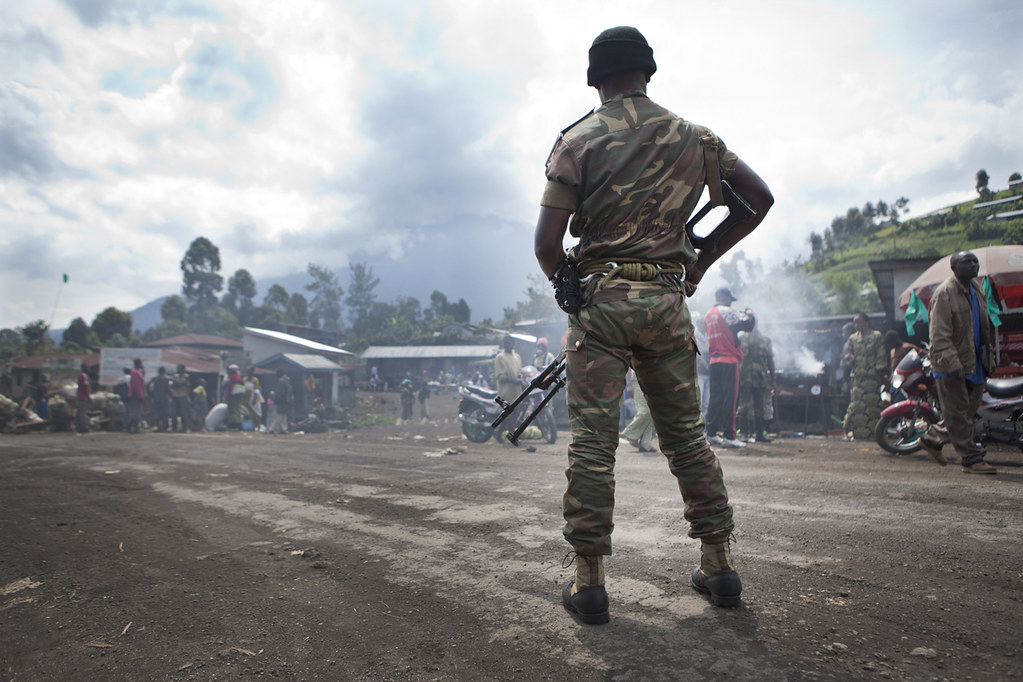
In the midst of a worsening security crisis, civilians in eastern Congo continue to be relentlessly targeted with violence by non-state armed groups, national security forces, and their partners. The national army (FARDC) has been unable to halt the advance of the Rwandan-backed M23 rebel group in the East.
Despite the deteriorating security situation, Congolese authorities have pushed for the continued drawdown of the UN peacekeeping mission deployed to the Democratic Republic of the Congo (DRC) over the last 20 years and have instead turned to a rotating cast of ad hoc international security actors to support their defense. These security arrangements have included bi-lateral operations by Ugandan and Burundian troops as well as the deployment of some regional militaries under an East African Community Regional Force (EACRF), and most recently the deployment of troops from the Southern African Development Community (SADC).
As EACRF troops were in the process of withdrawing and the SADC mission in the DRC (SAMIDRC) was being deployed in December 2023, CIVIC interviewed 61 Congolese civilians and civil society leaders in the Rutshuru and Masisi territories to investigate how civilians perceived regional armed actors deployed in eastern Congo.
Researchers sought civilian opinions on the mandate, activities, and impact of the EACRF, as well as their expectations and desires for the SADC deployment. While the EACRF has departed, civilians’ insights from its deployment remain relevant for the SAMIDRC and any other troop configuration that follows. Civilians’ views are often excluded from national decisions on security despite the direct impact on their survival and well-being.
As successive international deployments to eastern Congo have failed to curb the growing insecurity, civilians have become more frustrated and disillusioned. To break outside of this dynamic and prevent the situation from continuing to deteriorate, SAMIDRC will need to focus on addressing the security threats civilians face and develop a strategy for incorporating strong military-civilian engagement into its operations.
A Shift Toward Regional Deployments
The EACRF was authorized in July 2022 for an initial six-month mandate that was renewed once by the Congolese government. Troops—which hailed from Burundi, Kenya, South Sudan and Uganda—began arriving to the DRC in November 2022. Although the eastern DRC is plagued by more than 120 non-state armed groups, the primary threat that EACRF troops were deployed to address was the M23 resurgence and their fast advance in large swathes of North Kivu province.
The MONUSCO drawdown and deployment of EACRF and SAMIDRC reflects a broader trend of increasing reliance on regional and ad hoc peacekeeping deployments to address insecurity amidst a decline in host state support for the UN Peacekeeping model. But unlike UN peacekeepers, EACRF forces did not have an explicit POC mandate and lacked the doctrine, multi-dimensional expertise, and resources that tend to accompany such mandates in UN missions. Moreover, troops deploying into ad hoc regional arrangements do not always undergo vetting for past human rights violations as those deploying into UN missions do, creating a higher risk that they will inflict additional harm on already vulnerable civilians.
The vast majority of the civilians CIVIC interviewed—95 percent—did not feel that the EACRF deployment improved their security.
Only 5 percent felt that actions of the EACRF or the proximity of their bases had positive impacts on their personal security. “The protection of civilians was not their concern,” concluded a civil society leader interviewed by CIVIC. A civilian explained, “Schools were targeted and transformed into military assets. Pupils’ desks were used as firewood. Our children do not go to school. Some health structures have been attacked or destroyed and others were closed. …Armed groups looted our homes [and] our property, even in the presence of EAC forces, which neither reacted nor provided solutions.”
Understanding Causes of Civilians’ Dissatisfaction with the EACRF
Dissatisfaction with the EACRF performance appears to stem from a variety of issues. One clear cause is a lack of clarity and consensus about the mandate of the EACRF. While UN mandates are not always easily accessible to civilians or clearly understood by them, they are transparently made available to the public. The EACRF mandate was not.
A draft copy of the EACRF’s concept of operations reportedly stated that the Force would “contain, defeat, and eradicate negative forces.” The May 31, 2023 communiqué on the 21st Extra-Ordinary Summit of the EAC Heads of State further directed the EACRF to perform several roles, including, “to protect civilians and support the return of internally displaced persons to the areas vacated by armed groups.” Congolese government officials stated publicly on a number of occasions that the primary role of the EACRF was combatting the M23. The EACRF troop contributing countries, however, voiced divergent interpretations of what the Force’s mandate included. Some EACRF troops and troop-contributing countries seem not to have viewed protection of civilians as a core component of their role.
This lack of clarity and transparency on the mandate left civilians confused and dejected. Many civilians said they did not understand the mandate of the Force or pointed to gaps between what the Congolese government said the EACRF would do, and their experiences of its actions on the ground.
Emphasizing this point, a civil society leader said,
The Mission of the EAC is vague. …It’s a cacophony when the Tanzanian president says that the EAC did not come to fight the M23, but to build a buffer zone between the FARDC and the M23, while our president had announced an offensive deployment.
The ambiguity surrounding the EACRF mandate renders it difficult to fully assess the force’s efficacy or hold troops and troop contributing countries accountable for delivering on it. It also complicates the already challenging task of identifying coordination mechanisms to facilitate engagement between the EACRF and other forces such as MONUSCO or bilateral deployments.
Congolese civilians did not view EACRF troops uniformly. Several interview participants praised efforts of Burundian troops to intervene in M23 attacks and observed that their bases, troops, and patrols were more embedded in high-risk areas. On the other hand, the approach chosen by the Kenyan contingent to favor political engagement and negotiations with M23 to withdraw from occupied territories without combat raised discontent and suspicion among many civilians.
Congolese community members who spoke with CIVIC did not report experiencing direct harm from the EACRF operations. However, civil society and human rights organizations reported incidents of sexual exploitation and abuse (SEA) by some EACRF troops. But many civilians did equate failures by EACRF troops to intervene in violence as complicity with that violence. Some individuals even concluded, based on EACRF inaction, that there was collusion between the EACRF troops and the M23 rebels, made accusations that EACRF troops were extracting resources from the DRC for personal profit, or more generally viewed their intervention as extractive.
We don’t trust these forces… How could we have trust when these bordering countries are only exploiting our natural resources and depleting the Congolese budget?
Such perspectives are not surprising. They are rooted in decades-long intervention of regional actors in the DRC to advance their financial and geopolitical interests, including by funding armed actors in the DRC or and sending foreign troops into Congo to carry out illegal activities and occupation of territories. These perspectives underscore that, while there are benefits to regional peacekeeping deployments, there are also drawbacks to relying on troops whose historical involvement in conflict undermines perceptions of their neutrality. Misinformation and disinformation have also helped foster resentment against foreign troops in the DRC.
Such harmful messaging flourishes when troops fail to deeply understand community dynamics or engage with communities.
Conversely, strong community engagement is a proven component of effective protection of civilians. Congolese civilians told CIVIC that EACRF troops had tried to engage with them, but that those efforts had often gone awry by engaging the wrong people—including community leaders empowered by M23, or by emphasizing the wrong protection issues—like focusing on returns of displaced persons in areas still dominated by M23 forces.
Learning From the Past Rather Than Repeating It With the SAMIDRC and Other Protection Initiatives
Less than a year after the EACRF’s deployment, the regional force pulled out when the Congolese government decided not to extend its mandate owing to its inability, and to some extent, unwillingness, to neutralize M23 on the battlefield. From December 2023, the EACRF has been gradually replaced by troops from the SADC countries. The deployment has been endorsed by the African Union and SADC requested that peacekeepers from Malawi, Tanzania, and South Africa who were previously deployed with MONUSCO’s Force Intervention Brigade (FIB) be part of the SAMIDRC deployment. In 2013, the FIB led a decisive victory against M23 after the rebel group briefly occupied Goma.
SAMIDRC is deploying in an environment of skepticism with a lack of clear funding to support its work. Congolese in eastern DRC are increasingly wary of foreign deployments and few of those who spoke with CIVIC in Rutshuru and Masisi were optimistic about the arrival of the SADC troops. Those who held hope for them wanted to see SAMIDRC deployed under a transparent mandate, with a role of directly combating the most violent armed groups, a plan to deeply engage with Congolese civil society and civilians to understand local conflict dynamics, and accountability mechanisms for their performance. Several civilians also acknowledged the imperative of accompanying the SAMIDRC deployment with political initiatives. As a civil society leader stated,
The problem can be resolved politically or diplomatically if the actors in the crisis are sincere. The lesson shows us that the solution to this crisis will never be military but rather political.
For now, the SAMIDRC appears to be repeating some of the shortcomings of the EACRF rather than learning from the EARCF’s deployment. Although some civilians were aware in an abstract sense that there was a plan to deploy SADC troops, they lacked concrete information about the form and timing of this deployment. Insufficient effort seems to have been made to inform the population about the mandate and deployment arrangements of the SADC troops.
No press conference, no communication, difficult access of official information on SAMIDRC. Civilians were not informed. They realized that SAMIDRC was there when they saw their military vehicles arrive
an observer told CIVIC. Coordination with MONUSCO forces to strengthen POC imperatives also appears limited, six months after the regional mission’s deployment.
Most of the civilians CIVIC interviewed also wanted to see the Congolese government invest in training, equipping, and otherwise professionalizing the Congolese national army rather than continuing to vest significant responsibility for securing Congolese soil in foreign troops.
Security sector reform (SSR) rooted in local ownership and meaningful civil society inclusion is desperately needed to stabilize the DRC. So far, multilateral SSR initiatives failed to curve pervasive corruption, patronage and impunity in the Congolese security structure. They remained limited by poor political will for reform despite systemic violations of international humanitarian and human rights law by security actors.
A clear takeaway from these experiences is that whether troops are deployed to address insecurity under the aegis of the UN, the EAC, the SADC, or any other banner, they should be explicitly mandated to engage with and protect civilians, and they should implement this mandate as a priority. Consensus between troop contributing and host countries on a mission’s mandate public access to the mandate, and strategic public communication on the mandate are crucial. Likewise, regional organizations should consider the perceived and actual neutrality of troops. Civilians will expect to see and deserve accountability for mandate implementation and troop behavior.
Failing to provide clear, transparent, and protection-focused mandates for regional deployments could lead to greater proliferation of non-state armed groups. If the concerns that civilians reported to CIVIC about the EACRF are repeated in future deployments, frustrated Congolese desperate of effective protection and bombarded with mis and disinformation may increasingly reject these deployments and turn to local self-defense initiatives, contributing to further armed mobilization and militarization.