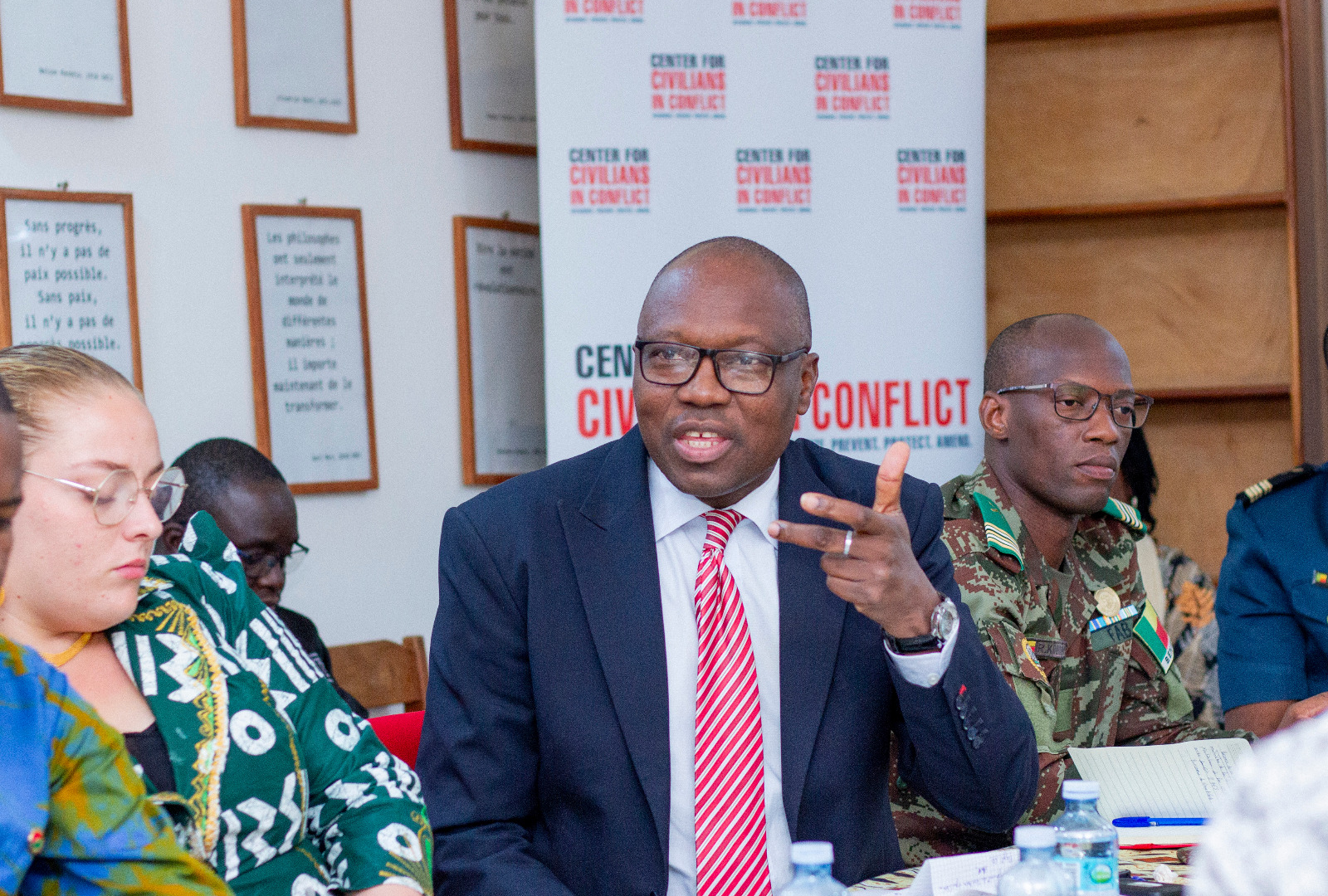
On 17 – 18 June 2026 in Cotonou, Center for Civilians in Conflict (CIVIC) and the Friedrich Ebert Stiftung (FES), with the support of Mr. Arnauld Kassouin, an analyst and independent consultant, organized a strategic reflection workshop on developments and challenges related to the protection of civilians in the north-eastern region of Benin. The workshop was held within the framework of the project “Supporting Community Protection Mechanisms in the Border Areas of Benin, Burkina Faso, and Togo,” implemented by CIVIC and supported by Global Affairs Canada. The workshop was prompted by the recent expansion of activities by non-state armed groups in the Sahel and north-western Nigeria, as well as the arrival of several waves of refugees fleeing insecurity in Nigeria and seeking refuge in the Alibori and Borgou departments.
The workshop brought together around thirty participants from diverse backgrounds, including policymakers, representatives of the embassies of neighboring countries (Burkina Faso, Niger, and Nigeria), personnel from the defense and security forces, including Operation Mirador, researchers and experts, traditional hunters, representatives of international organizations, technical and financial partners, humanitarian and community actors, and civil society organizations.
Read the full report in French, here.
Key Findings
1) The departments of Alibori and Borgou in Benin, the Dosso region in Niger, and the states of Kebbi, Kwara, and Niger in Nigeria are facing the activities of several non-state armed groups, notably Ansaru, Lakurawa, Mahmuda, and Jama’at Nasr al-Islam wal Muslimin (JNIM), an al-Qaeda-affiliated group. This security situation, which has recently emerged in these border areas, could transform them into a new “three-border zone” similar to the Liptako-Gourma region if urgent measures are not taken.
2) The lack of reliable data on these actors operating in the Benin-Niger-Nigeria tri-border area makes it difficult to fully understand the dynamics at play and to develop appropriate responses. Nevertheless, available research suggests that Mahmuda consists of two components: the Mahmuda Group and the Mahmuda Sadiku Cell.
3) The operational tactics of armed groups active in the northeastern corridor primarily include the use of improvised explosive devices (IEDs), kidnappings, and the theft of property and livestock. These activities undermine stability and threaten the safety and well-being of populations living along the Nigerian-Beninese border.
4) Traditional hunters, organized under the authority of village chiefs, now play an important role in security efforts and in combating armed groups alongside personnel from Operation Mirador. However, it is essential to mitigate the risks of abuse and prevent retaliatory attacks against traditional hunters and their families, which could fuel cycles of violence and exacerbate tensions within communities.
5) The armed groups that have been operating in the Sahel and the Lake Chad Basin for more than a decade are largely the same groups now active in the border areas of Benin and other West African coastal states. Similar operational patterns observed in the Sahel and Lake Chad contexts are also evident in these areas. These findings suggest that lessons learned from previous crises have not been sufficiently shared or institutionalized to enable effective anticipation of the expanding threat.
6) Terrorism tends to flourish in border regions characterized by structural inequalities, persistent marginalization, and limited access to public services. Through the Beninese Agency for the Integrated Management of Border Areas (ABeGIEF), Benin is addressing these root causes and strengthening the resilience of communities living in these regions. ABeGIEF’s experience shows that the success of such interventions depends on engaging local populations as active partners in security, rather than treating them merely as subjects of control.
Recommendations
The meeting produced six key recommendations. These mainly concern how Benin, in coordination with its partners and neighboring countries, can contain the threat in the northern border areas and prevent its spread further south.
1. Strengthen understanding of local threat dynamics and assess ongoing responses
Participants emphasized the need to invest more in research, analysis, and documentation of the security dynamics observed in border areas. A better understanding of the methods of establishment and operation of armed groups, combined with regular assessments of both security and non-security responses, would help generate valuable operational lessons. Such an approach would support the continuous adaptation of interventions and improve the ability to anticipate factors that could facilitate the expansion of the threat further south or the emergence of new areas for resource mobilization.
2. Draw on lessons learned from the Sahel and the Lake Chad Basin
Participants recommended increasing efforts to share knowledge, good practices, and lessons learned, including mistakes made in strategies aimed at preventing violent extremism and combating armed groups in the Sahel and the Lake Chad Basin. Disseminating these lessons among Beninese stakeholders involved in designing and implementing responses to insecurity could encourage the adoption of policies and practices that are better suited to cross-border realities and the evolving nature of the threat.
3. Strengthen regional cooperation and cross-border coordination mechanisms
Given its geographical proximity to several regional hotspots of insecurity and the weakening of certain regional cooperation frameworks, Benin is encouraged to continue and strengthen its efforts toward dialogue and pragmatic cooperation with neighboring countries, particularly Burkina Faso, Niger, Nigeria, and Togo. Participants stressed the importance of maintaining operational coordination and information-sharing mechanisms to ensure effective and timely responses to a threat that transcends national borders.
4. Adapt security and non-security responses by placing communities at the center of interventions
Participants recommended that all responses be increasingly informed by lessons drawn from local dynamics analyses, impact assessments, and regional experiences. This adaptation should place affected populations at the center of interventions, recognizing them as full partners rather than mere beneficiaries. It also requires the adoption of multidimensional approaches that foster stronger synergy among civilian, security, and military actors at all levels. Discussions further highlighted the need to improve coordination among the many projects implemented in northern Benin and to explore complementarities between security and defense, development, and humanitarian assistance approaches.
5. Implement transformative projects to reduce vulnerabilities
Participants underscored the importance of developing and introducing transformative projects in the areas most exposed to the threat in order to address the vulnerabilities that facilitate the establishment of armed groups. These initiatives should integrate the sectors of security, health, education, employment, and economic development, while ensuring the involvement of all segments of society, including foreign communities residing in these areas.
6. Regulate the participation of traditional hunters in security and defense efforts, particularly within Operation Mirador
Finally, participants noted that the recent involvement of traditional hunters alongside the Beninese Armed Forces in efforts to combat insecurity requires urgent reflection on how this collaboration should be regulated. This could include the development and dissemination of codes of conduct clearly defining the roles, responsibilities, and limits of intervention of the actors involved. Participants also recommended establishing awareness-raising and capacity-building activities on international humanitarian law, human rights, and civilian protection principles in order to promote practices consistent with national and international standards and to reduce risks to civilian populations.