
The UN General Assembly’s Fifth Committee, the Member State body that negotiates administrative issues and budgets, is getting closer to the June 30th deadline to approve the 2021-2022 peacekeeping budgets. During the final stretch, Member States should recognize that missions continue to provide critical protection to civilians, approve responsible budgets that reflect the security situation in mission contexts, and ensure that the budget process is resulting in adequate resources that match mission mandates.
Numbers Don’t Lie…
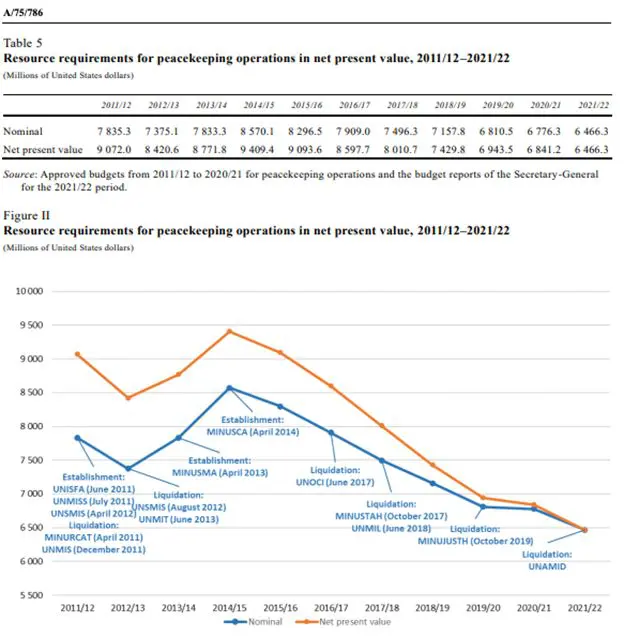
The number of peacekeeping missions and their budgets have decreased significantly over the last decade from peak-levels of over $8.5 billion dollars. This is especially apparent once the dollar figures are adjusted for inflation, as illustrated in the table and figure below, which was included in a recent Secretary-General’s overview report to the Fifth Committee. Mission closures in Haiti, Liberia, Cote D’Ivoire, and the current transition of UNAMID in Darfur, Sudan explain much of the downward trend. However, remaining missions have also felt the pinch, a casualty of a budgeting process that is in desperate need of reform.
Responding to this downward trend in budgets, missions are submitting budget requests that either maintain zero-growth or include cost reductions. Moreover, after missions submit their budgets, the budget negotiations are hardwired to impose cuts after cuts as the process moves forward.
First, an opaque and influential Advisory Committee on Administrative and Budgetary Questions (ACABQ), which is comprised of 21 members serving in their individual capacity, prepares recommendations on the overall budgets and individual line-items in the requests. The ACABQ’s recommendations almost always recommend cuts to the proposed budgets. Member States use the ACABQ recommendations as a baseline for negotiations. The ACABQ’s recommendations are not binding, but Member States tacitly agree to them to simplify incredibly complicated and detailed budget negotiations. Challenges to the ACABQ recommendations could open up Pandora’s box, giving permission to Member State negotiating blocs to engage in horse-trading with other blocs, which requires significant time and political capital that many Member States don’t have the capacity to commit.
Second, Member States often impose further cuts to the ACABQ’s recommendations. This could be for a range of potential reasons, including that Member States may feel missions fail to present a strong rationale for budget requests; assume that missions pad their budget requests or that imposing cuts will force missions to find efficiencies; and/or have ideological and political positions against peacekeeping writ large, specific missions, or specific mandated tasks. Mission planning and budget development processes need significant reform and efficiencies likely could and should be found, but downsizing budgets isn’t translating into action. Instead, they contradict Member State and Secretary-General commitments to match mandates with resources.
The table below illustrates how some of the big peacekeeping missions continue to submit budget requests that maintain zero-growth or include cost reductions. Missions’ ability to absorb cuts without impacts to mandate delivery have been hampered by the downward pressures of past years. This year, as the table below shows, the ACABQ is recommending steeper cuts than in previous years, despite a conservative approach taken by the missions. By recommending significant cuts, the ACABQ handicaps the negotiations. In response, Member States should push back against the ACABQ where possible.