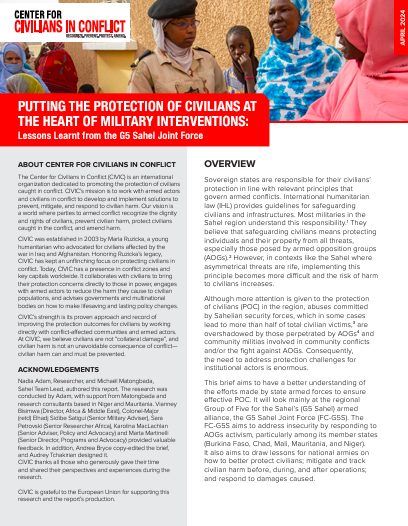
Sovereign states are responsible for their civilians’ protection in line with relevant principles that govern armed conflicts. International humanitarian law (IHL) provides guidelines for safeguarding civilians and infrastructures. Most militaries in the Sahel region understand this responsibility. They believe that safeguarding civilians means protecting individuals and their property from all threats, especially those posed by armed opposition groups (AOGs). However, in contexts like the Sahel where asymmetrical threats are rife, implementing this principle becomes more difficult and the risk of harm to civilians increases.
Although more attention is given to the protection of civilians (POC) in the region, abuses committed by Sahelian security forces, which in some cases lead to more than half of total civilian victims, are overshadowed by those perpetrated by AOGs and community militias involved in community conflicts and/or the fight against AOGs. Consequently, the need to address protection challenges for institutional actors is enormous.
This brief aims to have a better understanding of the efforts made by state armed forces to ensure effective POC. It will look mainly at the regional Group of Five for the Sahel’s (G5 Sahel) armed alliance, the G5 Sahel Joint Force (FC-G5S). The FC-G5S aims to address insecurity by responding to AOGs activism, particularly among its member states (Burkina Faso, Chad, Mali, Mauritania, and Niger). It also aims to draw lessons for national armies on how to better protect civilians; mitigate and track civilian harm before, during, and after operations; and respond to damages caused.
Read the full brief here.