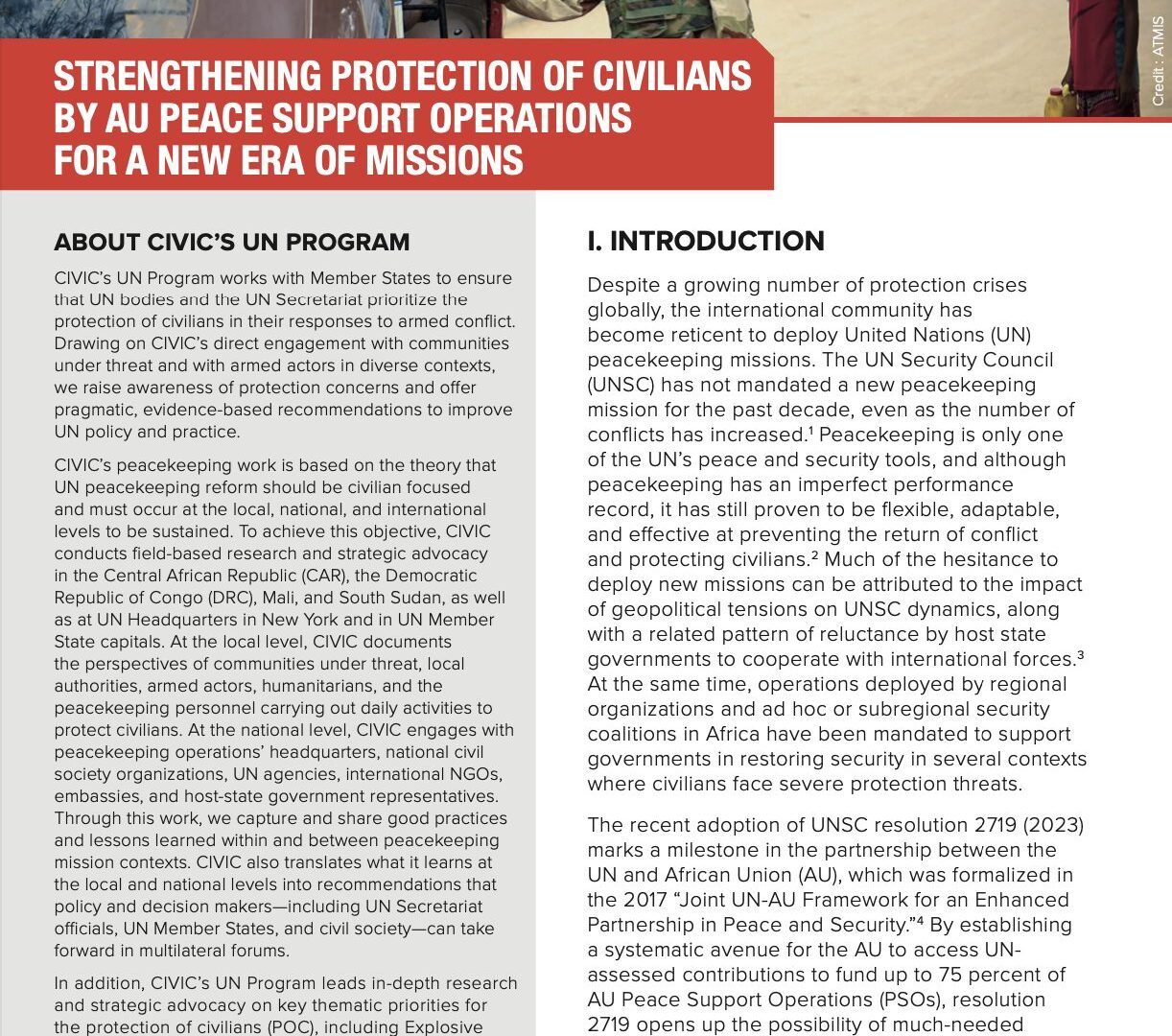
 An ATMIS Djiboutian soldier checks motorists accessing the bridge that connects Bulo Burto district over River Shabelle, in Hirshabelle State on 27 November 2022.
Despite a growing number of protection crises globally, the international community has become reticent to deploy United Nations (UN) peacekeeping missions. The UN Security Council (UNSC) has not mandated a new peacekeeping mission for the past decade, even as the number of conflicts has increased. Peacekeeping is only one of the UN’s peace and security tools, and although peacekeeping has an imperfect performance record, it has still proven to be flexible, adaptable, and effective at preventing the return of conflict and protecting civilians.
Much of the hesitance to deploy new missions can be attributed to the impact of geopolitical tensions on UNSC dynamics, along with a related pattern of reluctance by host state governments to cooperate with international forces. At the same time, operations deployed by regional organizations and ad hoc or subregional security coalitions in Africa have been mandated to support governments in restoring security in several contexts where civilians face severe protection threats.
The recent adoption of UNSC resolution 2719 (2023) marks a milestone in the partnership between the UN and African Union (AU), which was formalized in the 2017 “Joint UN-AU Framework for an Enhanced Partnership in Peace and Security.” By establishing a systematic avenue for the AU to access UN-assessed contributions to fund up to 75 percent of AU Peace Support Operations (PSOs), resolution 2719 opens up the possibility of much-needed sustained and predictable financing for AU-led missions. This enhanced level of international support to regional operations in Africa could result in positive impact on protection efforts and outcomes by enabling consistent resources for operations and training, for example.
In this context, discussions on the future of peacekeeping and regional peace operations, including at the upcoming 2025 Peacekeeping Ministerial, and on the implementation of the UNSC’s framework resolution on authorizing and financing AU PSOs (resolution 2719 (2023)), should foreground the need to deliver the best possible protection outcomes for civilians in peace operation contexts. Even though AU PSOs may be deployed in different types of conflicts than UN peacekeeping missions, and have different mandates as a result, PSO protection strategies and approaches could benefit from the lessons learned and good practices of past AU and UN peace operations.
This analytical brief draws on CIVIC’s programmatic engagement with African multilateral forces, as well as its extensive research on the protection of civilians (POC) by UN peacekeeping operations, supplemented by interviews with key UN and AU stakeholders to identify lessons for upcoming AU PSOs. After introducing the POC framework for AU PSOs, the brief highlights lessons from CIVIC’s experience with harm mitigation mechanisms in Africa, and draws relevant insights on integration, community engagement, and mission transitions in UN peacekeeping.