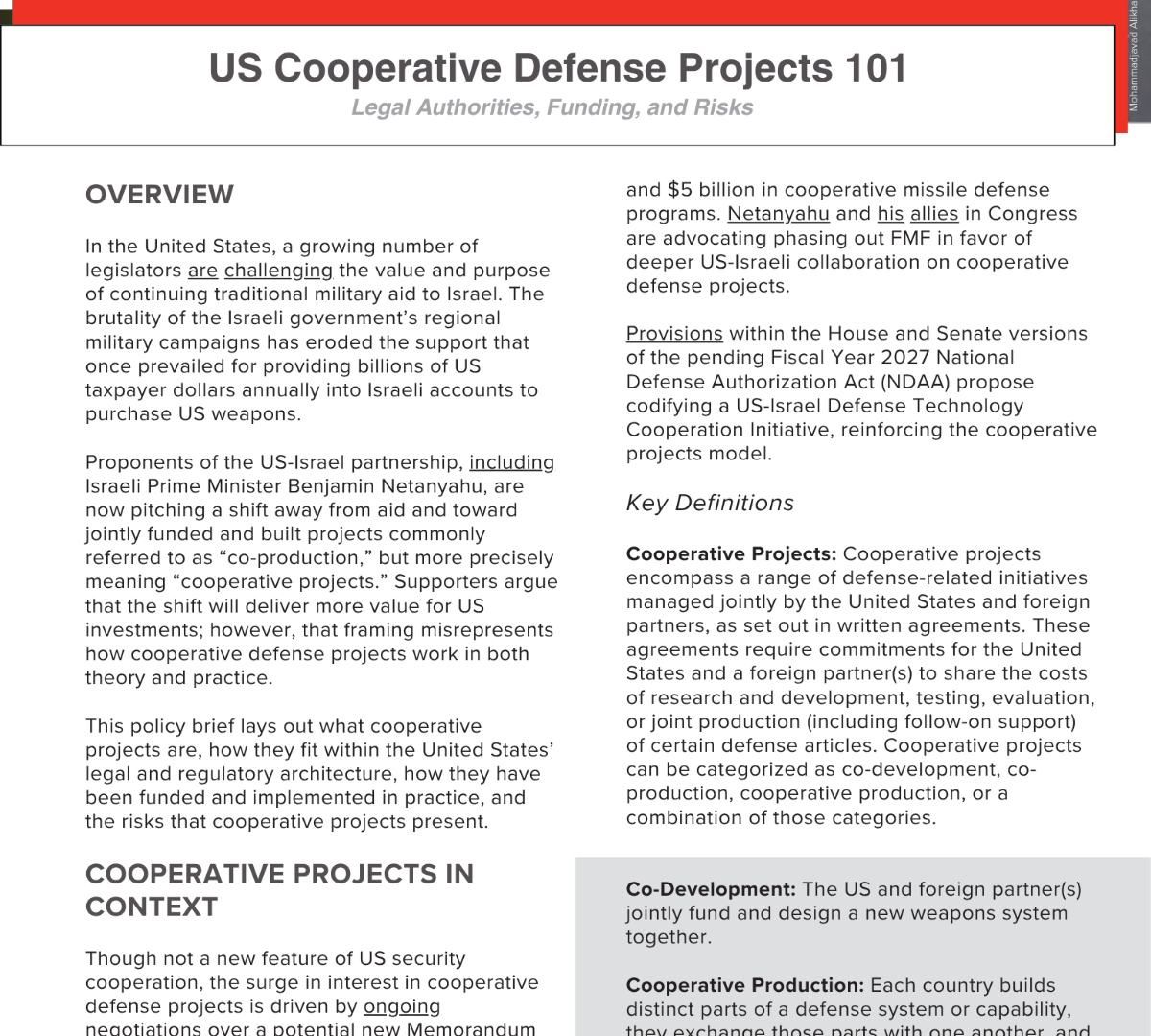
In the United States, a growing number of legislators are questioning the value and purpose of continuing traditional military aid to Israel. As support for providing billions of US taxpayer dollars annually for the purchase of US weapons has come under increasing scrutiny, proponents of the US-Israel partnership are advocating for a shift away from traditional aid toward jointly funded and developed initiatives commonly referred to as “co-production,” but more precisely described as cooperative defense projects.
Supporters argue that this approach could deliver greater value for US investment. However, cooperative projects are governed by a distinct set of legal, regulatory, funding, and oversight arrangements, and the way they operate in practice raises important questions about how such a shift would affect US security assistance policy.
This policy brief explains what cooperative defense projects are and how they fit within the United States’ legal and regulatory architecture. It outlines the different forms these arrangements can take, including co-development, cooperative production, and co-production, and examines how the United States and foreign partners share the costs of research and development, testing, evaluation, production, and follow-on support.
The brief also considers how cooperative projects have been funded and implemented in practice, with particular attention to US-Israel defense cooperation, and examines the risks associated with expanding this model as policymakers consider the future of US military assistance to Israel. In doing so, it provides readers with a foundation for assessing claims that cooperative projects represent a fundamentally different or more mutually beneficial approach to US-Israel defense cooperation.
Read the full brief here